This visual summary is based on the Syntactic Theory of Visual Communication by Paul Martin Lester, Ph.D..
Should you want to get your own copy of my illustrations, you can download them from here.
Lester's article is extremely interesting and relevant to the topics of visual thinking and communication, but it is not an easy read. In exploring the syntactic theory of visual communication, I have attempted to distill these complex concepts into a more digestible format. This theory, articulated by Lester, delves into how we interpret visual messages and the rules that govern their syntax.
From an early age, we are taught to read text but not images. Even though we start with drawings as children, we are gradually guided towards letters and words. As we progress through education, there's a noticeable divide: text is emphasized, while images and visual thinking tools are often sidelined. To play on the slogan from George Orwell's Animal Farm: "Pictures are good, but text is better!"
We are shifting towards a visually mediated society. Reading is increasingly overshadowed by visual consumption, which is less mentally demanding. Words are easily forgotten, but pictures stay in our minds for decades. This shift has been ongoing for a long time, as evidenced by concerns from as far back as 1955 about the impact of visual media on literacy (see: Why Johnny Can't Read). The concern at the time was that an overload of images and visual media might impede reading skills. Lester highlights that visual messages follow their own syntax, which may be lost on those who are text-oriented. Thus, the new generation is also reading, but they are reading something different.
There is a clear distinction between text and images. Text is sequential and discursive, meaning it's organized in a linear narrative. In contrast, images are holistic, offering a comprehensive view at a glance. Pictures lack formal grammar and a standardized visual alphabet, making them challenging to "read" in the traditional sense. Susan Sontag argues that without narration, understanding through images is limited. However, as we consider this, we must also acknowledge that text, because it is sequential, cannot be understood without grammar and syntax. Without these elements, readers would have no way of deciphering the connections between the serial flow of signals. One could argue that the notion of grammar and syntax is a side effect or necessity stemming from the limitations of serial communication.
Semiotics, the study of signs and symbols, provides insight into how images function as a form of communication. Images are essentially collections of signs that convey meaning through viewer interpretation. While visuals can be powerful, they communicate most effectively when paired with verbal or written explanations.
Semiotics is divided into three domains:
Pragmatics: Studies the origins and uses of signs.
Semantics: Explores the significance of signs across cultures.
Syntactics: Focuses on combining signs to form messages.
Pragmatics and semantics are important but not unique to visual communication. Syntactics asserts that a sign by itself means nothing; meaning depends on other signs. The right combination of words and pictures can create a very effective synergy. For instance, research on newspaper reading shows that people first notice the photograph, then the caption, and finally the headline before delving into the article. This interplay of text and image enhances comprehension and impact. Since thinking always involves communication—whether to ourselves or others—a thoughtful orchestration of text and images in communication enhances our ability to see connections and find solutions.
According to Wilson Hicks, an early picture editor for Life magazine, "It is not correct to say that either medium [words and pictures] supplements the other. The right verb is complements."
This brings us to the conclusion of Lester's article, where he articulates his theory in three main tenets:
Words and images share a deep connection. Words originated from visual symbols, and over time, text gained prominence. With Gutenberg's press, words gained dominance over images, leading to a decline in visual literacy as text became standardized. Just consider how a printed page from Gutenberg’s press compares to a codex page from a visual stimulation standpoint.
However, both mediums are crucial in communication, each contributing unique elements.
Both words and images are symbolic. They represent ideas and concepts that are understood through cultural and contextual knowledge.
We remember images by verbalizing them. Concrete nouns like "ball," "book," "bottle," "baby," etc., are recalled much better than abstract concepts such as "freedom," "peace," "ethics," or "love." Illustrations can help make abstract concepts more memorable by translating them into tangible (concrete) forms.
Text and Visuals Complement Each Other: Both play a reinforcing role in note-taking and communication. Aim for a cohesive design that aligns visuals with captions and text for maximum impact.
Deliberate Design: As we move towards a more visually-oriented society, balancing the use of words and images will facilitate better cross-cultural understanding and communication.
Visuals as Information Compression: Images can condense complex ideas into a single glance. Use visuals to summarize and reorganize information efficiently. (I demonstrate how I organize concepts using their visual summaries into a narrative at the end of my video Book on a Page Summary of Atomic Habits by James Clear and in Excalidraw Writing Machine)
The Importance of Narration: Adding verbal summaries to visuals is essential for making them truly effective. Use tools like Back-of-the-Card Notes in Obsidian-Excalidraw or slide notes or captions in other tools, to integrate visuals with text.
Transforming Abstract to Concrete: Creating illustrations involves converting abstract ideas into concrete forms, which aids memory and understanding. For more on the craft of creating concept visuals, check out my video Mastering Concept Visualizations: A Simple Workflow for Creating Effective Visuals.
Invest in Visual Skills: Given the emphasis on writing in traditional education, investing time in learning illustration can provide greater value. Consider exploring visual thinking courses to enhance your skills. Visit the Visual Thinking Workshop to learn more.
By embracing both text and visuals, we can enhance our ability to communicate complex ideas effectively and enrich our understanding of the world around us.
Finally, if you want to explore this topic further, check out my video on the topic:
Follow the links below to learn more about Visual Thinking, Note-Taking, and Personal Knowledge Management (PKM). See my work in action.
Why Visual Thinking is the Missing Link in Your PKM
When we think about personal knowledge management (PKM), writing often takes center stage. We’re taught to jot down thoughts, organize them neatly, and create complex networks of notes. But is text alone enough to fully capture, process, and present the depth of our ideas? I argue that it’s not...
The Syntactic Theory of Visual Communication
From an early age, we are taught to read text but not images. Even though we start with drawings as children, we are gradually guided towards letters and words. As we progress through education, there's a noticeable divide: text is emphasized, while images and visual thinking tools are often sidelined...
What is the purpose and role of visual thinking?
Isn’t thinking more than just visuals? Why the heavy focus on visuals?
Aren’t we losing important elements of thinking by only using visuals?
Can visuals really improve my thinking? Why is most of the workshop about communication?
How Visual Thinking Transformed My PKM
As someone who has spent years developing tools like Excalidraw and ExcaliBrain for Obsidian, I’ve now moved most of my Personal Knowledge Management (PKM) into a visual-first approach. My problem-solving and thinking process usually begins with throwing words and icons onto a virtual whiteboard...
A non-visual guide to visual thinking
was recently at a family picnic where one of my cousins, curious about my YouTube channel and online course, asked, "Can you explain what you do, in simple terms? And why would someone care?"
To be honest, I struggled to articulate it clearly. I am so involved in the details that I find it really hard to explain the essence of...
and learn about visual thinking...
I selected 9 videos as an introduction to my Visual PKM work...
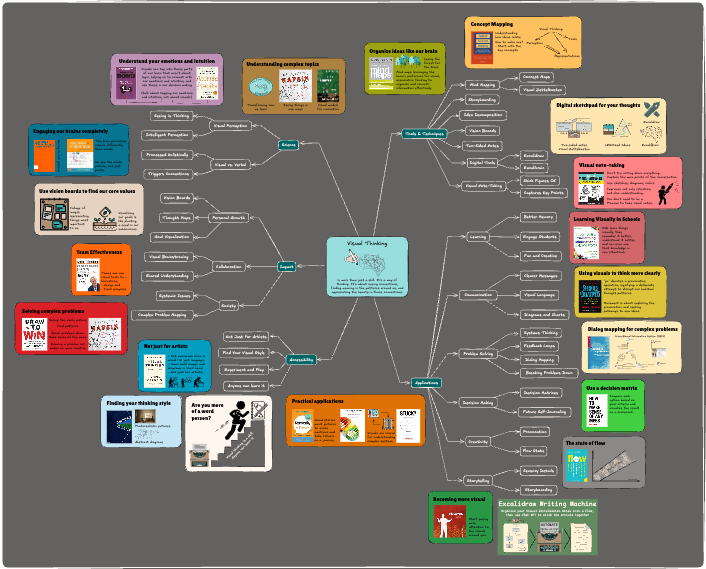
Discover the benefits and applications of Visual Thinking in this AI-Generated Podcast. While machine-produced, the content is thoughtfully curated from 40 of my favorite books and articles. This engaging 36-minute deep dive explores the many facets of Visual Thinking. To enhance your experience, I've also created an Excalidraw mind map for easy exploration and interactive note-taking.