As someone who has spent years developing tools like Excalidraw and ExcaliBrain for Obsidian, I’ve now moved most of my PKM into a visual-first approach. My problem-solving and thinking process usually begins with throwing words and icons onto a virtual whiteboard or scribbling on a physical one, just to get the ideas out of my head so I can look at them and play with them. Once clusters of thoughts start to emerge, I organize those clusters into more targeted, simple illustrations or diagrams. Then, I flip to the other side of the sheet and start to write. Writing is essential for my thought process, but I’ve found that starting with visuals helps me organize my ideas far more effectively.
Over the years, I realized that my thinking has always been visual, but the tools I used would often get in the way. Whether it was paper or static digital illustrations, I couldn’t modify or update them as my ideas evolved. This lack of flexibility was frustrating. I needed my illustrations to be dynamic and modifiable, constantly evolving as my thinking developed.
This was a very large part of the reason why I created the Obsidian-Excalidraw plugin, which now has over 2.6 million downloads. Excalidraw allowed me to develop a workflow that is not only visual-first but also adaptive and easy to modify. But I believe this issue goes deeper than just tool functionality.
A large part of the frustration many people experience comes from a disconnect: many of us are visual thinkers by nature, yet our education has never developed this skill. Schooling is heavily text-oriented, leaving little room for students to learn how to express themselves through simple illustrations, mind maps, or concept maps. Sure, many of us took art classes, but how often did we learn to sketch ideas in history or literature?
This educational gap has resulted in people having the inner urge to create spatial, visual representations of their ideas but lacking the skills to do so. They often struggle, feeling limited to silly stick figures or messy diagrams, and eventually give up, saying, “I’m not good at drawing, so I’ll just stick to text.” The reality is that they’ve simply never been taught the right tools and techniques to help them harness their visual thinking abilities.
Unfortunately, the issue goes even deeper; you could say there is a vicious cycle. Because very few of us were lucky (I am not one of them) to have teachers at school instruct us in the craft of visual thinking, many software tools lack the vision to support it. Sure, there are mind mapping apps, but I am yet to find one that offers both decent hand-drawn illustration features and good linking abilities. There are illustration tools like Apple's Freeform, but reuse is by copy-pasting, not by linking. There are great drawing tools like Procreate or Autodesk Sketchbook, but they lack a strong textual component. And there are PKM and note-taking tools like Obsidian, Notion, Evernote, etc., but they fall short on the illustration side. Because we’ve never been given the chance to learn visual thinking at school, we simply don’t create tools that are effective at supporting it.
One of the biggest barriers to adopting visual thinking is inertia. I’ve seen it firsthand in my Visual Thinking Workshop, where participants hesitate to make their first drawing. Some will wait until session four or five before they’ve created anything, wanting to get it right on the first try.
But the truth is that there is no “right” way to start. Visual thinking is a skill you develop through practice. Scribbling something, even if it’s messy or doesn’t seem coherent, is much better than waiting to do it perfectly. The only way to become better at visual thinking is to dive in and do it, without worrying about how polished it looks.
Let me share an example from my own experience. The MindSET framework, which is a core part of my Visual Thinking Workshop, didn’t emerge overnight. Back in Cohort 1, I didn’t have the framework at all. I simply created a mind map to track ideas from each session. In Cohorts 2 and 3, I would revisit the same mind map, reworking and adding new details as the course evolved.
To access The MindSET Framework including all the cards and supporting materials, sign up for the Visual Thinking Workshop.
It wasn’t until Cohort 5 or 6 that the idea of the card forcing function emerged, inspired by the concept of baseball cards. I wanted to create a set of visual cards that would represent the key concepts in visual thinking, using both images and text. These cards helped me organize my ideas into sessions and a logical flow. I now have 33 cards, including the latest addition, Take a Stand.
Once the cards were created, I could use them as a tool for organizing the workshop and as a structure for referencing external sources like Annie Murphy Paul’s book, Tiago Forte’s ideas, or Nick Milo’s Linking Your Thinking system. The process of visually deconstructing concepts and then layering them with additional information helped crystallize the framework.
This method—starting with visuals, crystallizing ideas, and then using writing to develop them further—has been my core approach to problem-solving. It’s the same process I applied to create the MindSET framework, and it’s one that can help you transform your own PKM.
To get you started with visual thinking, I’m introducing a simple exercise: the Forcing Function. The idea here is to introduce a constraint—a standard-sized frame, such as a card or post-it note—that compels you to distill your ideas into a concise, visual representation. The act of creating this forced, distilled version helps you focus on the key concepts and leave out unnecessary details.
Here’s what the card looks like:
Pick a topic, challenge, or concept you’re working on.
Scribble some ideas on a virtual or physical whiteboard.
Set up a limited area (like a card or post-it note) to force yourself to distill the main points into a single concept visual.
Use a mix of words and visuals to capture the essence of the idea.
If you prefer to work manually, grab a sheet of A4 paper and some post-it notes. This process works just as well on paper as it does with digital tools.
Don’t wait. Pick up a virtual whiteboard or a piece of paper and start sketching your ideas. Try creating two or three cards to capture the main points of an article you’re reading or a challenge you’re trying to solve. Remember, you don’t have to get it right the first time. The act of doing it is far more important than waiting to perfect it.
Follow the links below to learn more about Visual Thinking, Note-Taking, and Personal Knowledge Management (PKM). See my work in action.
Why Visual Thinking is the Missing Link in Your PKM
When we think about personal knowledge management (PKM), writing often takes center stage. We’re taught to jot down thoughts, organize them neatly, and create complex networks of notes. But is text alone enough to fully capture, process, and present the depth of our ideas? I argue that it’s not...
The Syntactic Theory of Visual Communication
From an early age, we are taught to read text but not images. Even though we start with drawings as children, we are gradually guided towards letters and words. As we progress through education, there's a noticeable divide: text is emphasized, while images and visual thinking tools are often sidelined...
What is the purpose and role of visual thinking?
Isn’t thinking more than just visuals? Why the heavy focus on visuals?
Aren’t we losing important elements of thinking by only using visuals?
Can visuals really improve my thinking? Why is most of the workshop about communication?
How Visual Thinking Transformed My PKM
As someone who has spent years developing tools like Excalidraw and ExcaliBrain for Obsidian, I’ve now moved most of my Personal Knowledge Management (PKM) into a visual-first approach. My problem-solving and thinking process usually begins with throwing words and icons onto a virtual whiteboard...
A non-visual guide to visual thinking
was recently at a family picnic where one of my cousins, curious about my YouTube channel and online course, asked, "Can you explain what you do, in simple terms? And why would someone care?"
To be honest, I struggled to articulate it clearly. I am so involved in the details that I find it really hard to explain the essence of...
and learn about visual thinking...
I selected 9 videos as an introduction to my Visual PKM work...
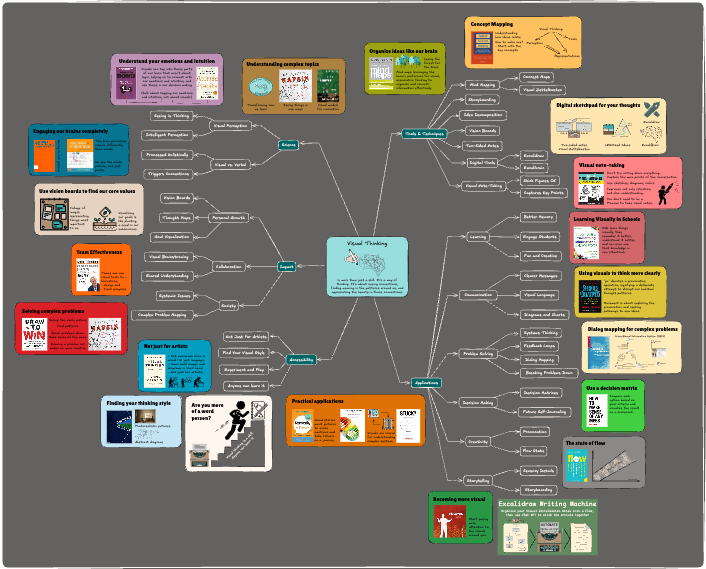
Discover the benefits and applications of Visual Thinking in this AI-Generated Podcast. While machine-produced, the content is thoughtfully curated from 40 of my favorite books and articles. This engaging 36-minute deep dive explores the many facets of Visual Thinking. To enhance your experience, I've also created an Excalidraw mind map for easy exploration and interactive note-taking.